Last updated 20 August 2026
How we measure
Every piece here is measured at three points and the difference from the drawing is published beside the photograph. This page says how that is done, under what conditions, and what we will not do with the result.
Questions about this page
Hong Kong Bolin Rui International Trade Limited
support@starlivehk.com
[+852 number to be filled in before launch]
Room 1508, 15/F, Office Tower II, Argyle Centre, 625 Nathan Road, Mong Kok, Kowloon, Hong Kong
The registered office is an address of record. It is not open to callers.
Contact form →The method
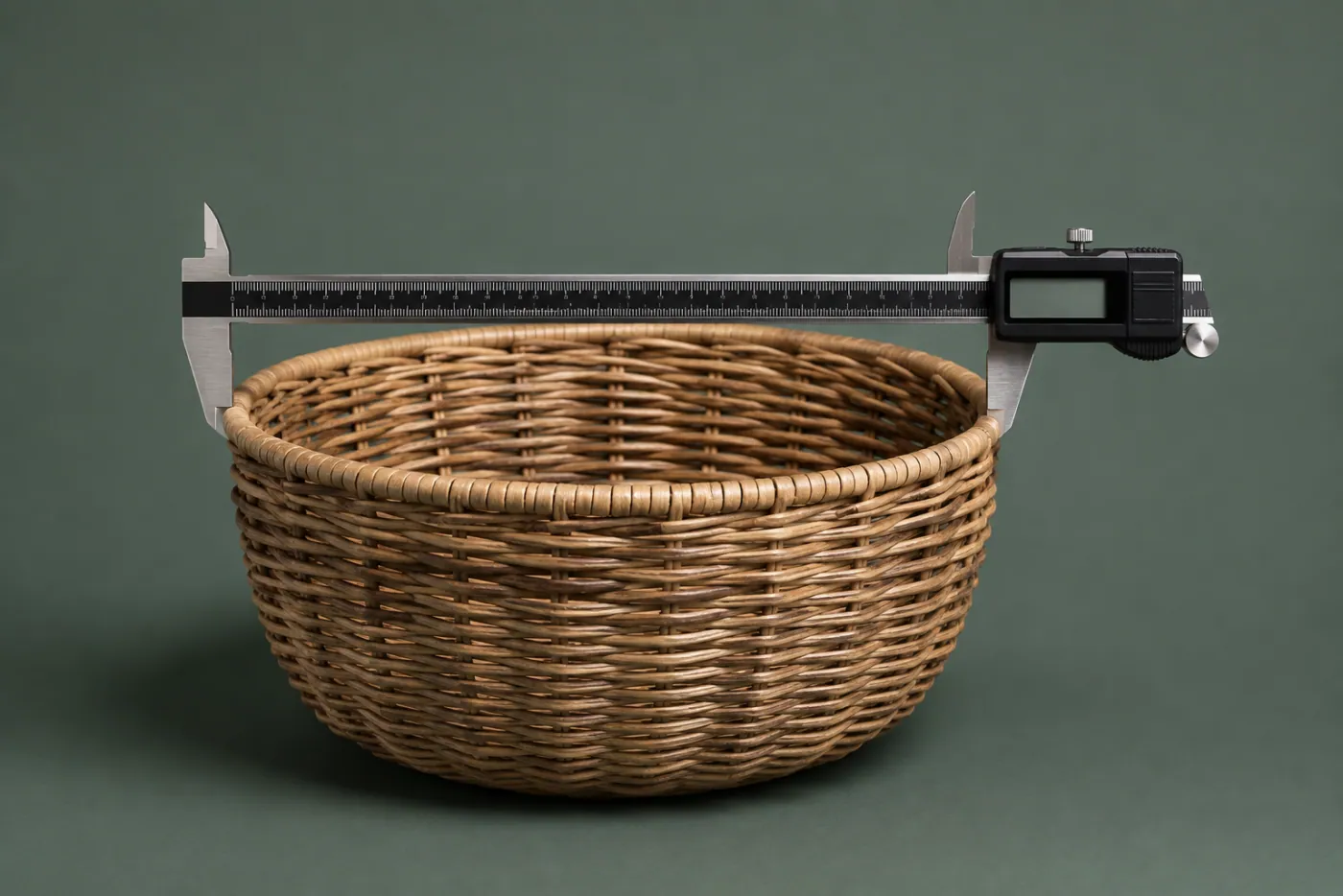
Each piece is measured at three points with a digital calliper, at 22 °C and 50–60% relative humidity, forty-eight hours after the weaving is finished. Natural fibre moves with humidity; a piece measured in a damp room reads larger, and a piece measured the moment it comes off the form has not finished settling.
The three points depend on the shape. For a basket they are the mouth at its widest, the height excluding any handle, and the base. For a tray they are the diameter, the height and the base. For a wall disc they are the diameter, the diameter again taken at ninety degrees to the first, and the thickness — two axes on the same disc, because a disc that is out of round is out of round in a way one figure cannot describe.
We publish the difference from the drawing. On the piece’s page you see the drawing figure, the measured figure and the difference, in a table, in millimetres, alongside a drawing of the two outlines laid over each other. Both outlines in that drawing are built at one scale, so the gap you can see is the gap that exists.
What we do not do with it
We do not grade pieces by it
A piece 11 mm off the drawing costs exactly what a piece 2 mm off costs. There is no “seconds” shelf, no discount for being further out, and no premium for being closer in. The deviation is that piece’s identity, not its score. Two pieces made from the same drawing, one wider and one narrower, are the clearest case:
| Point | Drawing | This piece | Difference |
|---|---|---|---|
| Mouth diameter (widest point) | 280 | 284 | +4 mm |
| Height (excluding handle) | 220 | 220 | 0 |
| Base diameter | 175 | 178 | +3 mm |
| Point | Drawing | This piece | Difference |
|---|---|---|---|
| Mouth diameter (widest point) | 280 | 276 | −4 mm |
| Height (excluding handle) | 220 | 218 | −2 mm |
| Base diameter | 175 | 172 | −3 mm |
Same drawing, same materials, same recorded weaving time, same price. One came out 4 mm over at the mouth and the other 4 mm under. Charging differently for those would mean pretending one of them is the real one.
We do not retouch the photographs
The flaws stay in the pictures and are named in the text: where the strand broke, where the joint is, where the burr lifts, which side the rim dips on. Every one-of-one piece has a field for this and the field is not allowed to be empty — the site will not build if one of them says “none”.
We do not photograph one piece and ship another
The photograph on a piece’s page is of that object. When it sells, the page goes. The number is not reused on anything else, ever. Where a piece comes back to us under the returns promise and goes back on the shelf, it keeps its original number and its original published measurements, and the page says it has been returned.
What the figures are not
They are not a tolerance specification and they are not a quality standard. They describe one object, once, under stated conditions. Measure the same piece yourself in a room at 80% humidity and you will read differently, and that is a property of plant fibre rather than a fault in either measurement. See what the fibre does.
A piece that arrives matching its published measurements is as described. A piece that arrives with damage we did not publish is not, and that is a separate matter — see terms and returns.